A function whose inputs are software data and whose inputs are software data and whose output is a single numerical value that can interpreted as the degree to which software possesses a given quality attribute.
We want to keep track of a project or organization level metric, not an individuals performance.
Measure
- Quantitative indication of the extend, amount, dimension, capacity, or size of some attribute of a product, project, or process Measurement
- Act of determining a measure Metric
- Quantitative measure of the degree to which a system, component, project, or process possesses a given attribute
- May relate individual measures Indicators
- Metrics that provide insight into software processes, projects, or products against a standard threshold
Objectives
- Assist management in three basic area
- Control of software development projects and software maintenance
- Support of decision making
- Initiation of preventive or correcting action
- Facilitate managerial control, planning & intervention based on calculation of metrics regarding deviations of the actual from planned in terms of functional and timetable and budget performance
- Identify situations for development or maintenance process improvement based on accumulation of metrics information regarding the performance of teams, units, etc
Software Size Measures
- KLOC: Classic measure of the size of software by thousands of lines of code
- Function points: A measure of the development resources required to develop a program, based on the functionality specified for the software system
Types of Metrics
- Process metrics:
- The point here is to improve software processes
- Defect metrics
- Effectiveness of defect removal
- Productivity
- Product metrics
- These are the characteristics of a product
- Refer to development phase
- Refer to operational phase
- Project metrics
- These are project characteristics and execution
- Staffing pattern over the life cycle
Limitations of software metrics:
- Obstacles
- Are enough resources allocated for developing and collecting metrics
- Opposition from employees
- Uncertainty regarding the data’s validity rooted in partial and biased reporting
- Low validity and limited comprehensiveness of metrics
- KLOC is not a very good estimate for development time
- Defects detected depend on thoroughness of review/testing and reporting style
Detection Strategies
Randu Marinescu:
- Detection strategy: A composition of various metric rules combined with AND/OR operators into a single rule
- Metric rules: Metrics that should comply with proper threshold values
- The composition of metric rules expresses a violation of a design heuristic
The point of this is to turn our metrics and informal rules into strategies to detect stuff like large complex classes.
Data Filter Examples
- Marginal
- Semantical
- Statistical
- Interval
- Composition of two marginal filters We use boolean operators to combine data filters to make detection strategies to find stuff.
DECOR
This is a method for the specification and detection of code and design smells based on domain specific language.
DETEX is a detection technique that instantiates DECOR.
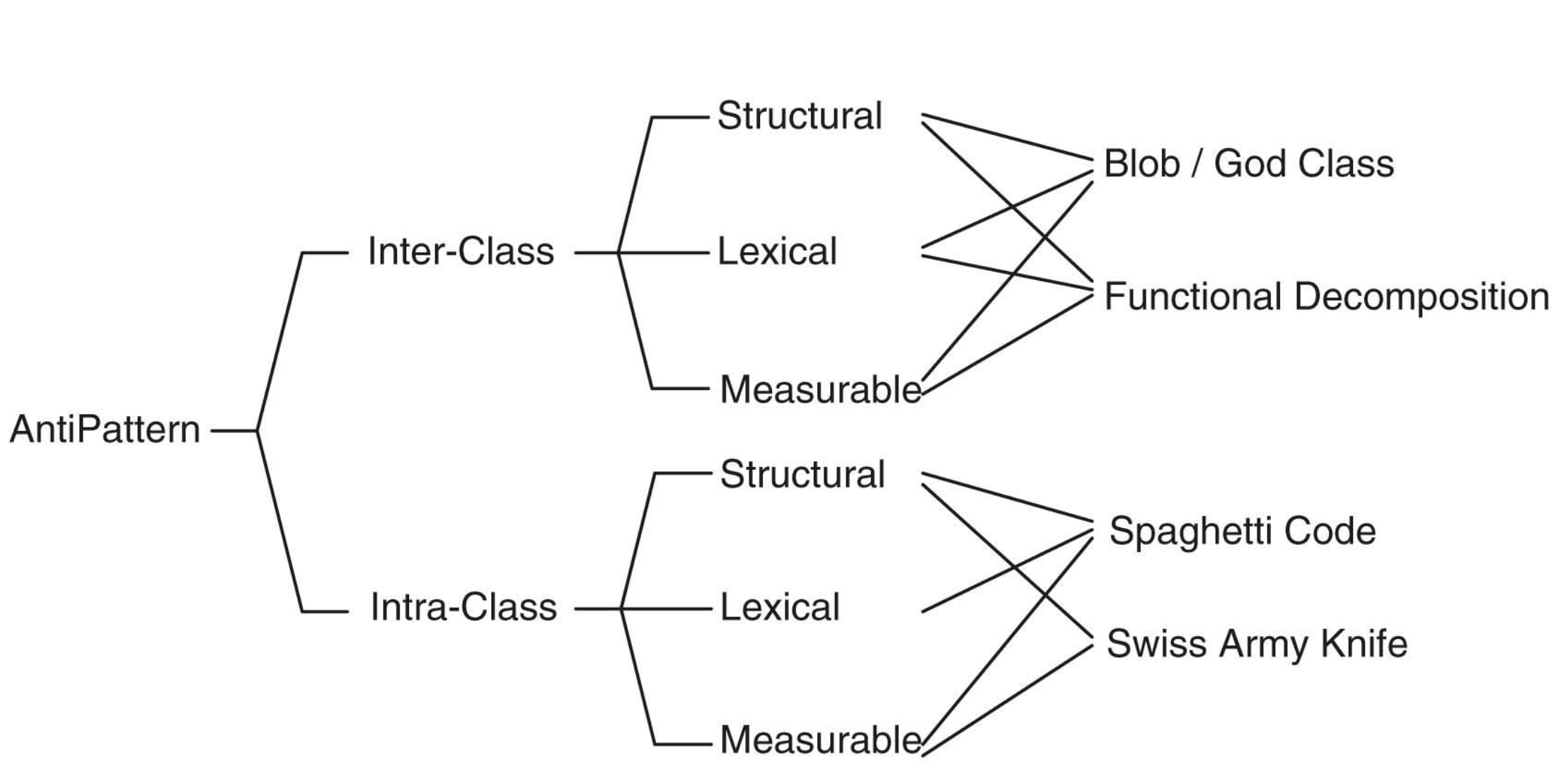
Anti Patterns and Code Smells
Anti Patterns
Code Smells
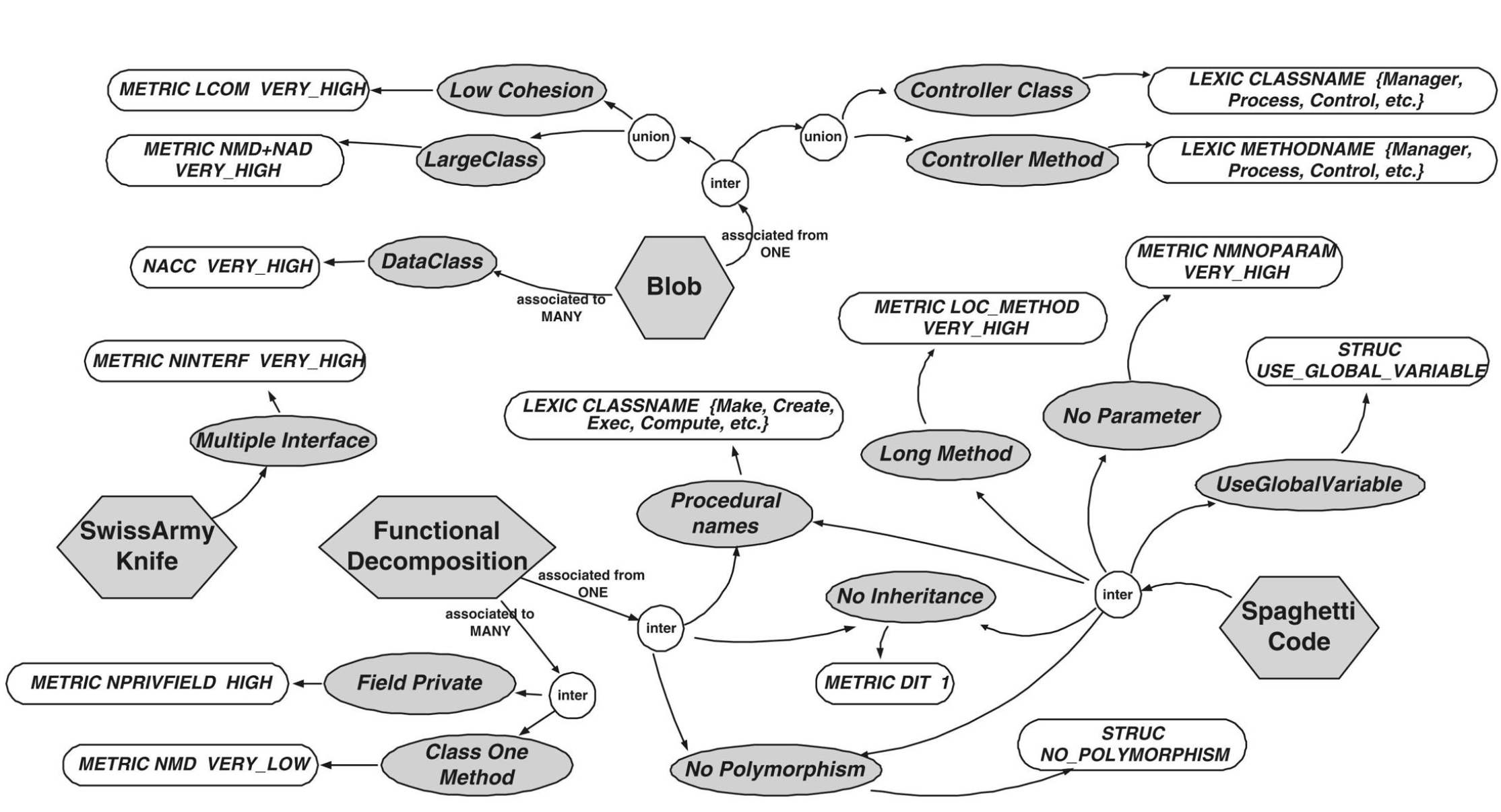
You automatically generate detection algorithms from DECOR rule cards.