Definition
is Schur if roots()
Lemma
Let
If is Schur, then
Basically saying the leading coefficient of the highest degree needs to be bigger in size than the ending coefficient of the smallest degree term.
There are however limitations to this lemma. If the lemma does not hold, then we know for sure that is not Shur, but just because the lemma holds, could still not be Shur.
Are We Shur?
Let and where this basically just flips the order of the coefficients where is nth order.
We want a lower order polynomial for testing if is Schur (instead of testing directly). We could do this recursively or iteratively until we get to a low enough order that its really easy.
The idea here, is that we want to cancel out and divide by , to give us a lower order polynomial.
To do this…
Where at where the will cancel out eventually leading to where this is
Final Equation and is of order n-1.
Lemma
Suppose
Then is Schur iff is Schur
Lemma
Boundary crossing lemma…
Let and and if is Shur and is not Shur (or the other waya round), then there exists such that has a root on the unit circle
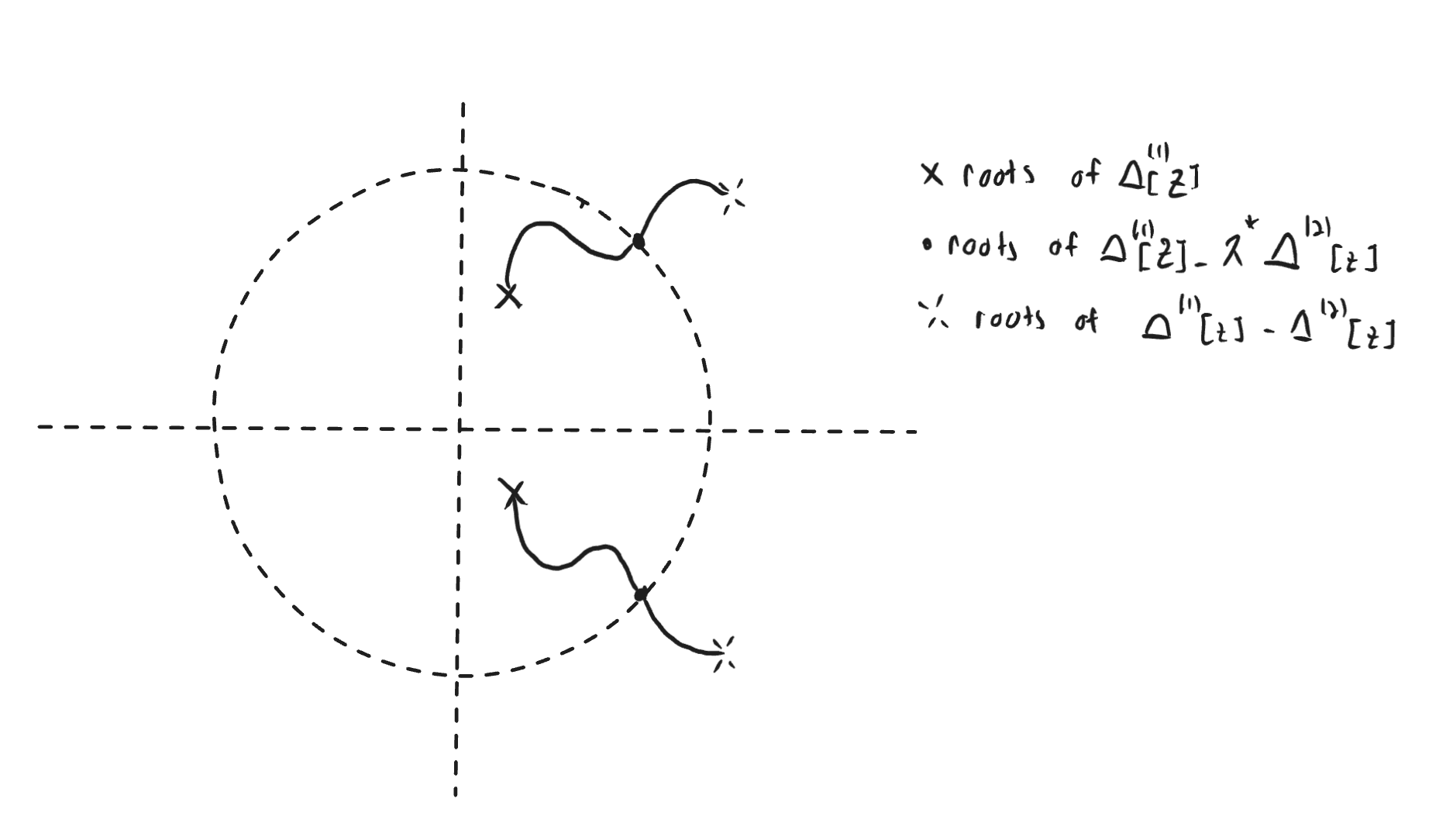
Proof by picture
Defining we want to keep applying polynomial reduction such that we get an of order 1 ()
At each stage we can check if our at that given degree (stage) is Shur.
At any point if is not Shur, we can stop.
We may need to go all the way until order 1 where has one root at and which is our base case.
General Algorithm
- Given: for some
- Check:
- is ?
- if not, is not Shur [by the lemma from class, we can stop]
- is not Shur and is not Shur [lemma from class]
- if true, set and repeat
- Stop with
- Do coefficient Shur test and make decision
For each we need to check if . Assume (if not just multiply by ). Note that where .
What is the point of this weird derivation?