This method is based on assembling this table…
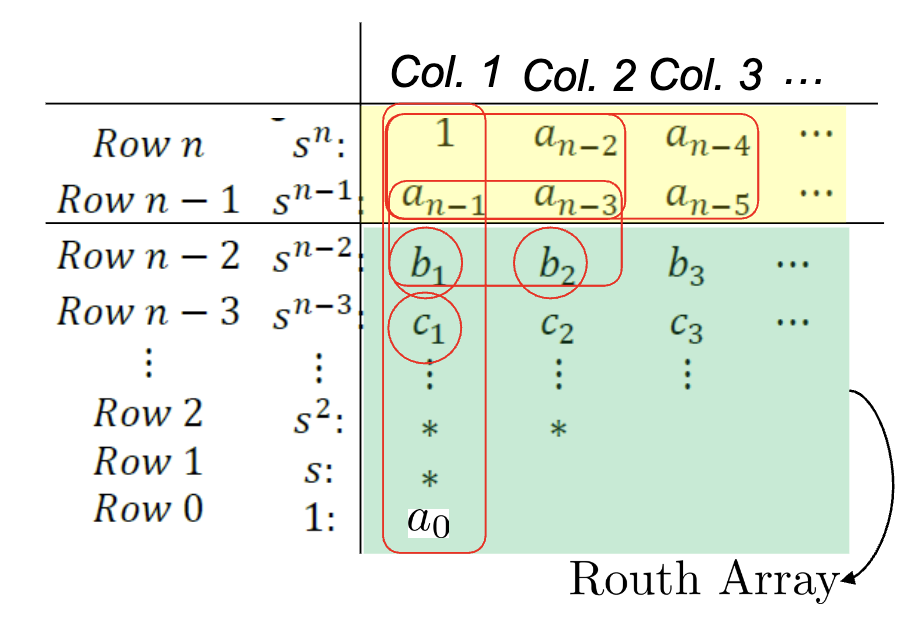
- You fill up the first two rows and then use these equations to fill up the rest…
- The first row is made of even subtractions of n
- The second row is made of odd subtractions of n
- This will full out triangularly
- The anchor for a row is the leftmost element in the row above where the anchor is the denominator term
- The number of roots with positive real parts is equal to the number of sign changes in the first column
- Empty slots in the right of each row are all zero
- The last element is always
Solving
- Simplify transfer function
- Expand denominator
- Write down Rauth table and solve for stability
Special Case 1
- If an element in the first column = 0…
- We replace the zero by a small positive number ()
- Apply the rule by taking the limit as needed
- If there is no sign change, the system is not unstable (Happens when some poles lie on the imaginary axis (marginally stable))
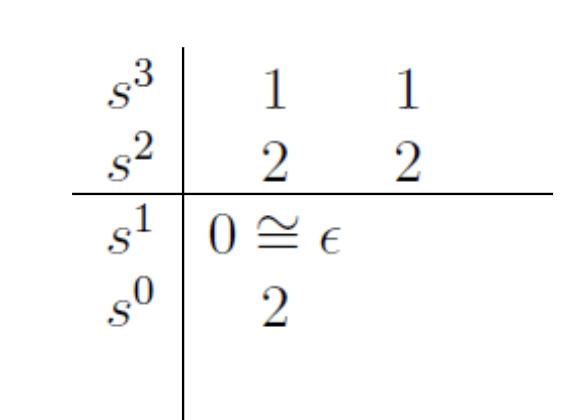
- You basically just skip that cell
Special Case 2
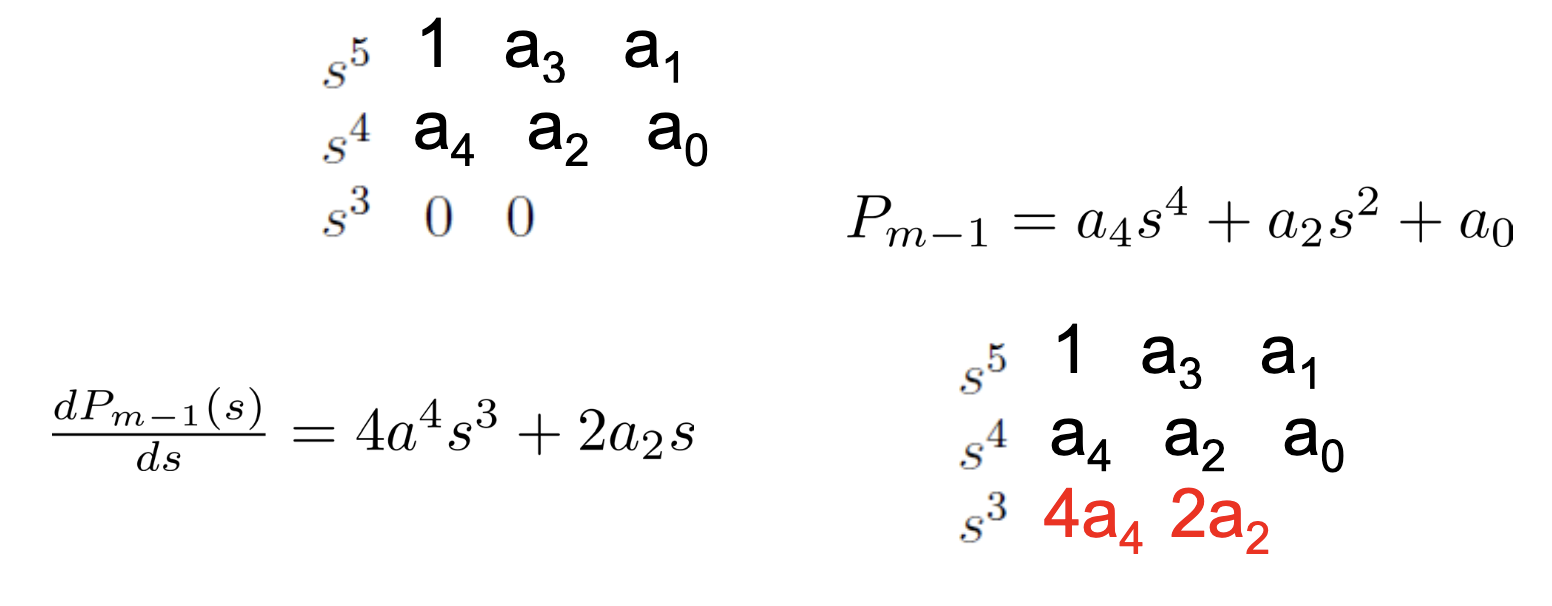
- If all elements in some row are zero
- You can get the row before row m where row m is the row containing all zeroes by using the terms in the row above the row m
- You need to form an auxiliary polynomial using these coefficients
- Then, take its derivative
- Use the coefficients of the derivative polynomial to fill up the row containing all zeroes